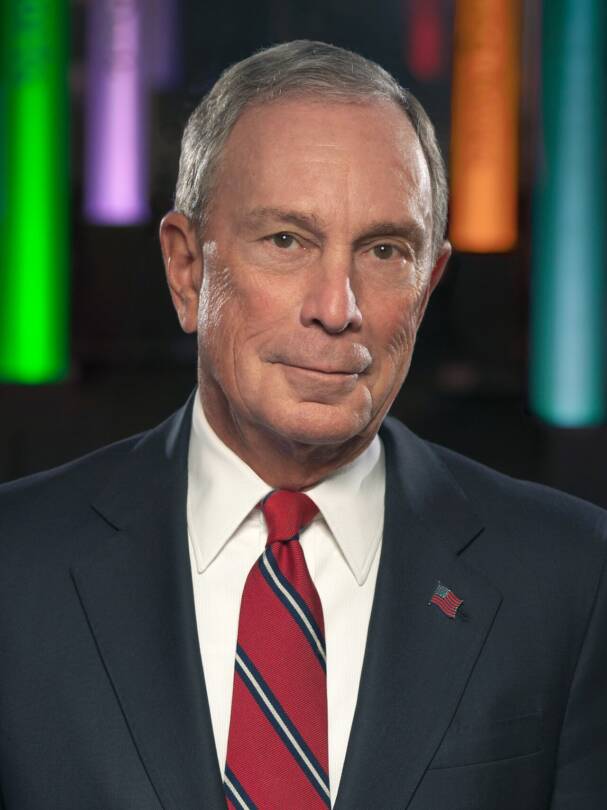
When you hear the name Mike Bloomberg, what comes to mind? Perhaps a three-term mayor of New York City, a prominent philanthropist, or a brief, incredibly expensive presidential candidate. But beneath these public roles lies a financial reality that few truly grasp: a self-made fortune so immense it redefines the very concept of political influence and personal giving. He isn’t just rich; he’s a centibillionaire, a titan whose wealth dwarfs that of many nations, built on the bedrock of financial data and information. His public service was largely self-funded, a stark contrast to the typical politician’s reliance on donors, painting a unique portrait of power and capital.
Who Is Mike Bloomberg Financially?
Let’s cut straight to the numbers. As of December 2025, Michael Bloomberg’s estimated net worth stood at a staggering $109.4 billion, placing him among the 17th richest individuals globally. This isn’t just a large sum; it’s more than the combined wealth of numerous U.S. senators and governors. His financial empire is largely private, centered on Bloomberg L.P., the financial information and media powerhouse he co-founded. The company, which he majority-owns, generates estimated annual revenues of nearly $15 billion. This colossal figure underscores a financial independence that few public figures can claim, allowing him to operate on a scale almost unimaginable to others.
The Business of Being Mike Bloomberg
Mike Bloomberg’s name is synonymous with Bloomberg L.P., the company that is the engine of his wealth. Founded in 1981, the firm revolutionized how financial professionals access real-time market data and analytics. Its flagship product, the Bloomberg Terminal, is ubiquitous on trading desks worldwide, commanding an annual subscription fee of approximately $24,000 to $27,000 per user. With over 325,000 subscribers globally as of 2022, the terminal alone is a formidable revenue generator, accounting for more than 85% of Bloomberg L.P.’s annual income. Beyond the terminal, the company’s ecosystem includes Bloomberg News, Bloomberg Television, and Bloomberg Radio, all contributing to a comprehensive financial information service. Bloomberg retains an 88% ownership stake in this privately held enterprise, meaning the vast majority of the company’s success directly translates into his personal fortune. His business model isn’t about monetizing his political career; it’s about providing indispensable tools to the global financial industry, a service so ingrained that it has become a standard.
Assets Worth Knowing About
Beyond his controlling stake in Bloomberg L.P., Michael Bloomberg possesses a substantial and diverse portfolio of personal assets. His real estate holdings alone were estimated to be worth over $100 million as of 2020, a figure that has likely appreciated since. In New York City, he owns an expansive Upper East Side townhouse, initially purchased in 1986 for $3.5 million, which, through the acquisition of adjacent properties and extensive renovations, is now estimated to be worth more than $50 million. He also holds a condo in a Trump-owned building on Park Avenue, acquired in 2000 for $3.8 million, now valued at approximately $4.2 million. For his philanthropic endeavors, he bought a Beaux Arts building on East 78th Street for $45 million in 2006 to house Bloomberg Philanthropies. His global footprint extends to a $10 million equestrian estate in Wellington, Florida, purchased in 2016, a ski resort condo in Vail, Colorado, and a London residence acquired in 2015 for $25 million. These are not just properties; they are strategic investments and personal retreats scattered across prime locations, reflecting a discerning taste for high-value real estate.
The Wealth Trajectory
Michael Bloomberg’s ascent to centibillionaire status is a classic American success story, albeit on an unprecedented scale. His career began on Wall Street in 1966 at Salomon Brothers. After 15 years, he was fired in 1981, receiving a $10 million severance package. This severance became the seed capital for his new venture, Innovative Market Systems, which would soon become Bloomberg L.P. The company’s early growth was bolstered by a $30 million investment from Merrill Lynch in 1984 for a 30% stake. However, Bloomberg steadily consolidated control, notably buying back Merrill Lynch’s remaining 20% stake in 2008 for $4.43 billion, a transaction that valued the entire company at $22.5 billion. From an estimated $4 billion net worth in 2001, his fortune surged to $35.5 billion by 2015, then rocketed to $106 billion by 2024, and $109.4 billion by December 2025. This exponential growth was driven by the relentless demand for financial data, the global expansion of his company, and his unwavering majority ownership.
Quirks, Controversies and Context
Bloomberg’s wealth often intersects with his public life in fascinating, sometimes controversial, ways. During his 12 years as Mayor of New York City, he famously accepted an annual salary of just $1, rejecting the full mayoral salary which would have amounted to $2.7 million over his tenure. Even more remarkably, he personally spent an estimated $650,000 of his own money on city expenses during his time in office, including a staggering $6 million on private plane travel. This self-funding extended dramatically to his unsuccessful 2020 presidential campaign, where he poured over $1 billion of his personal fortune into the race, making it the most expensive self-funded primary campaign in U.S. history. He effectively spent approximately $23 million for each delegate he won. Beyond politics, Bloomberg is a prolific philanthropist, having given away over $21.1 billion in his lifetime. A lesser-known fact is his commitment to donate his entire stake in Bloomberg L.P. to Bloomberg Philanthropies upon his death, if not sooner, ensuring his wealth continues to serve public causes long after he’s gone. This unprecedented pledge highlights a unique approach to legacy, transforming a private financial empire into a perpetual engine for global good.
Frequently Asked Questions
References & Sources
Last updated: March 2026. Net worth estimates are based on public financial disclosures and independent research.