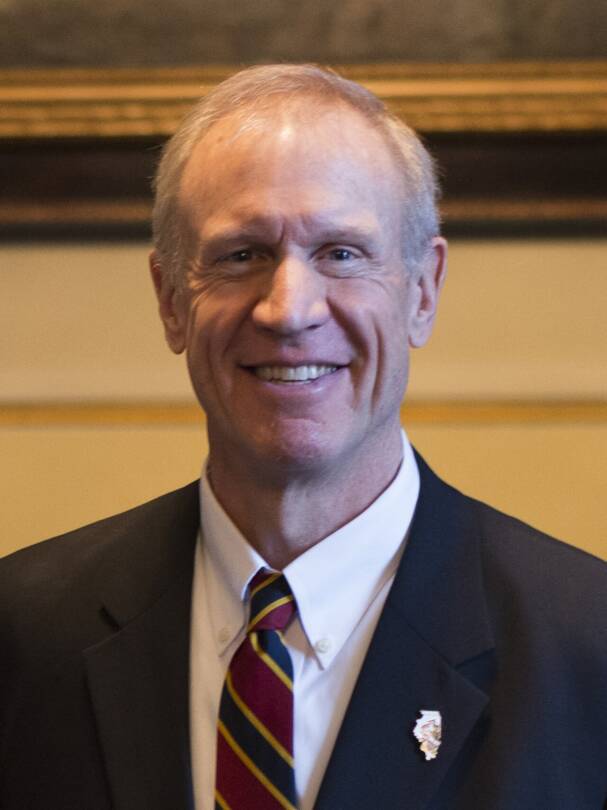
Bruce Rauner Net Worth 2026: The $400M Private Equity Fortune
42nd Governor of Illinois
Bruce Rauner Net Worth 2026: The $400M Private Equity Fortune Net Worth & Financial Report
Table of Contents
Four hundred million dollars. That’s the estimated net worth of Bruce Rauner, the former Illinois governor, a figure that might surprise those who only know him from his political career. But Rauner’s financial story is less about public service and more about a decades-long, high-stakes game in the world of private equity, a realm far removed from the average taxpayer’s experience. His wealth, a testament to shrewd investment and aggressive business strategies, dwarfs the typical earnings of even the most successful politicians.
The Private Equity Powerhouse Behind Bruce Rauner’s Investments
Before his foray into Illinois politics, Bruce Rauner spent over three decades building a formidable career at GTCR, a Chicago-based private equity firm he co-founded. He joined the firm in 1981, fresh out of Harvard, and by the time he retired as chairman in October 2012, GTCR had become a titan in its field. Rauner’s approach was often described as a “buy-and-build” strategy, identifying promising industries, recruiting top executives, and then acquiring companies to consolidate and grow them. It was a strategy that paid off handsomely. Consider VeriFone, a company whose payment terminals are ubiquitous in retail stores. GTCR bought a majority interest, restructured it, and turned a $60 million investment into a staggering $860 million return. That’s the kind of financial alchemy that built Bruce Rauner’s wealth.
After leaving GTCR, Rauner didn’t exactly retreat to a quiet retirement. In 2013, he opened R8 Capital Partners, a self-financed venture firm with plans to invest up to $15 million in smaller Illinois companies. This move underscored his continued commitment to the investment world, even as he began to eye the political arena. His deep roots in venture capital and private equity are the bedrock of his financial standing, shaping not just his personal fortune but also his economic philosophy.
Beyond the Governor’s Mansion: Bruce Rauner’s Assets and Real Estate
While serving as governor, Rauner and his family resided in the Illinois Governor’s Mansion, but their personal real estate portfolio extends far beyond Springfield. The Rauners own ranches in both Montana and Wyoming, properties that speak to a lifestyle of considerable means. These aren’t just vacation homes; they represent significant tangible assets in his overall financial picture. And it’s not just sprawling ranches. In 2019, after his governorship, Rauner listed his eight-bedroom, seven-bathroom custom Nantucket-style mansion in Winnetka, Illinois, for nearly $3 million. This sale offered a glimpse into the kind of luxury real estate holdings that contribute to a net worth like Bruce Rauner’s.
Here’s something many people don’t realize: Rauner faced scrutiny over his financial dealings even while in office. He publicly stated he would place his investments in a blind trust to avoid conflicts of interest upon becoming governor in 2015. Yet, it turns out it wasn’t a truly blind trust. Instead, he signed a power of attorney that allowed him to retain authority over his investments alongside a New York firm. This arrangement became a point of contention when a lawsuit alleged he participated in meetings about his cut of a $67.5 million settlement months after taking office, despite his public declarations. It’s a detail that complicates the narrative of a politician completely detached from his vast financial empire.
The $1 Salary and the Bruce Rauner Salary Paradox
Perhaps one of the most widely known, yet still surprising, facts about Bruce Rauner’s time as governor was his decision to accept only a $1 salary, forgoing all benefits and pension. This gesture, often seen as a symbol of his commitment to public service and a contrast to career politicians, masked the true financial engine of his political ambitions: his own wallet. While a governor’s salary in Illinois is around $177,412 annually, Rauner’s personal contributions to his campaigns dwarfed this figure by orders of magnitude.
He poured a staggering $26 million of his own money into his successful 2014 gubernatorial campaign. And that was just the beginning. In 2016, he deposited another $50 million into his campaign account for his reelection bid, a move described as a “first installment”. By the 2018 election, he had gambled nearly $60 million of his own fortune on the race. This self-funding capability allowed him to run campaigns on a scale few traditional politicians could ever dream of, fundamentally altering the financial dynamics of Illinois politics. Compare that to Bernie Sanders, whose net worth sits around $3 million, or even Donald Trump, whose net worth is estimated at $5.6 billion. Rauner’s willingness to personally finance his political endeavors is a stark illustration of how personal wealth can fuel a political career.
Capital Gains and Bruce Rauner’s Income Strategies
The sheer scale of Bruce Rauner’s income during his political tenure offers a window into the ongoing profitability of his investments. In 2015, his first year as governor, Rauner reported an adjusted gross income of $187.6 million, with almost $170 million of that coming from investments. The following year, 2016, saw him earn $91 million, again largely through capital gains. These figures are not just large; they highlight a financial strategy heavily reliant on the growth and sale of assets rather than traditional employment income.
Here’s a fact most people genuinely don’t know: despite his multi-million dollar annual income, Rauner frequently paid little to no Social Security or Medicare tax. This is because a significant portion of his earnings came from capital gains, which are taxed differently than regular wages. For example, in 2015 and 2016, years he reported nearly $279 million in adjusted gross income, he paid no self-employment tax, which covers Social Security and Medicare for those without regular paychecks. It’s a perfectly legal, yet often misunderstood, aspect of how the very wealthy manage their tax obligations, showcasing the distinct advantages of investment-derived income.
Philanthropy and the Scope of Bruce Rauner’s Wealth
Beyond his personal investments and political spending, Bruce Rauner’s financial footprint extends into significant philanthropic endeavors, primarily through the Rauner Family Foundation. This New York-based organization, supported by Bruce and Diana Rauner, holds assets exceeding $55 million. The foundation actively funds projects across various U.S. cities and states, demonstrating a broad charitable reach.
The Rauners have been particularly generous in the realm of education. Bruce provided major funding for the construction of the Rauner Special Collections Library at Dartmouth College, his alma mater. He also endowed full professorships at prestigious institutions like Dartmouth, Morehouse College, the University of Chicago, and Harvard Business School. In 2008, he was recognized with the Distinguished Philanthropist award by the Chicago Association of Fundraising Professionals. These contributions, totaling millions of dollars annually from the foundation, offer a different perspective on Bruce Rauner’s wealth, showing a commitment to giving back that runs parallel to his aggressive business pursuits.
Key Takeaways: Bruce Rauner’s $400 million net worth in 2026 is primarily rooted in his extensive career in private equity, particularly his tenure at GTCR. His financial profile is marked by substantial capital gains from investments, significant real estate holdings including ranches in Montana and Wyoming, and a notable philanthropic footprint through the Rauner Family Foundation. His political career, characterized by a symbolic $1 salary, was heavily self-funded, with tens of millions of his personal fortune directed towards campaigns, highlighting the immense financial power he wielded outside of traditional political income streams.
Bruce Rauner’s financial narrative is a complex tapestry of high-stakes investing, strategic wealth management, and a willingness to leverage personal fortune for political ambition. His journey from a private equity magnate to a governor who accepted a dollar a year is a study in contrasts, revealing how immense private wealth can intersect with public life. And it leaves one to wonder: how many more figures in public service command such vast, often unseen, financial empires?
Frequently Asked Questions
References & Sources
Last updated: March 2026. Net worth estimates are based on public financial disclosures and independent research.